¶ Visualiser Technical Application Guide
¶ Glossary of Terms
¶ 1. Valence & Arousal
-
Valence: A continuous affective dimension measuring intrinsic positivity versus negativity on a normalised scale (mapped between to in the SDK).
-
Valence Spike: A rapid, high-magnitude upward or downward inflection in the continuous valence curve occurring within a brief window of consecutive frames.
-
Average Valence: The mathematical mean of all valid valence samples recorded for a specific subject across their tracked session frames.
-
-
Arousal: A continuous affective dimension measuring physiological and cognitive alertness, intensity, or activation (mapped between to in the SDK).
-
Arousal Spike: A rapid, high-magnitude upward or downward inflection in the continuous arousal curve occurring within a brief window of consecutive frames.
-
Average Arousal: The mathematical mean of all valid arousal values logged for a specific subject across the video timeline.
-
-
VA Heat Map: A 2D density representation of the Valence-Arousal model, illustrating the clustering and dispersion of emotional trajectory points over time.
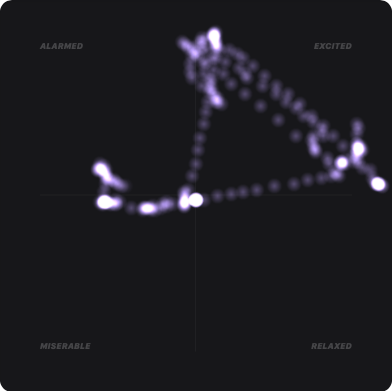
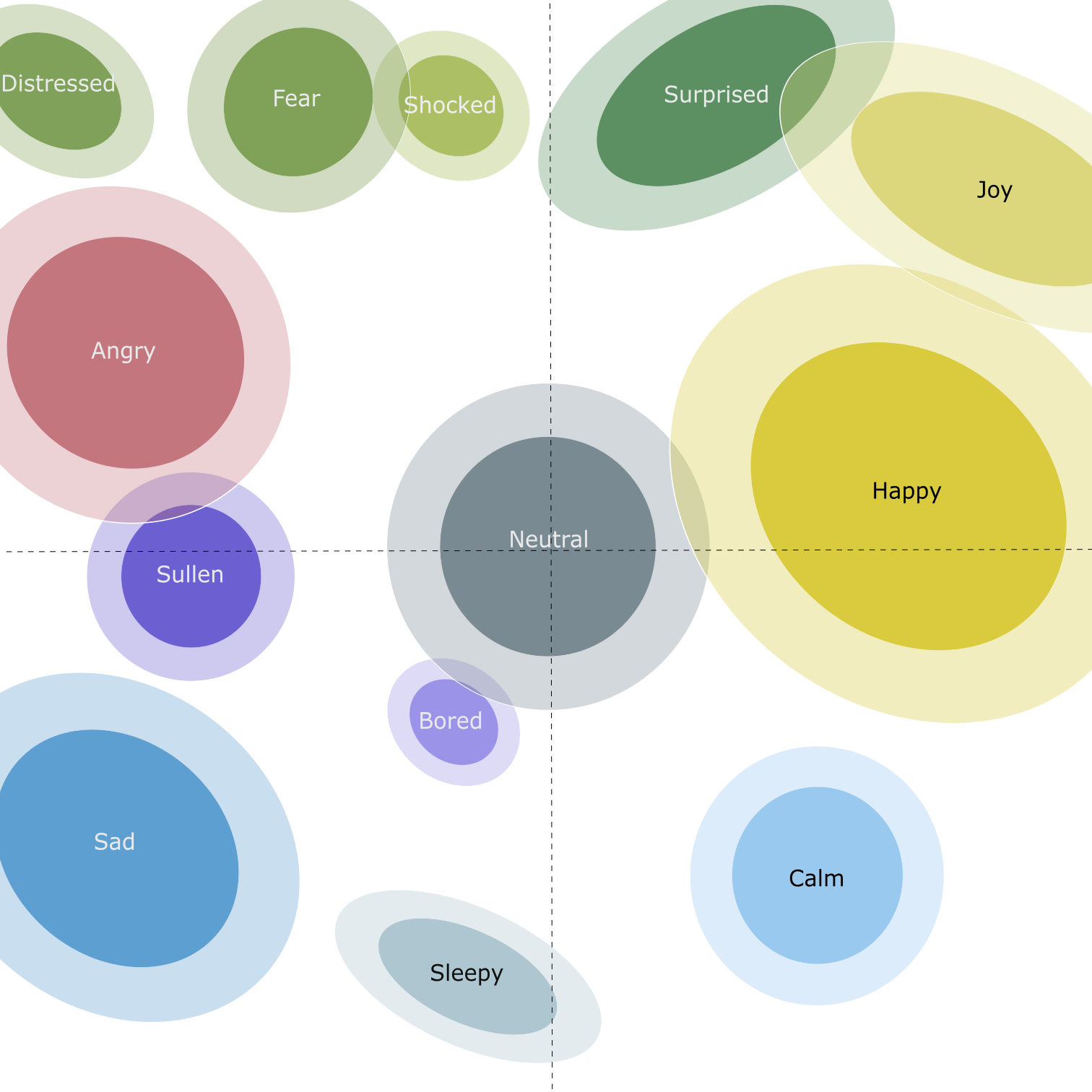
- Emotion Map: The interactive 2D coordinate plane within Visualiser plotting real-time Valence against Arousal. It displays live tracer tracking, path history, and boundary quadrants representing the user's trajectory through different emotional states.
¶ 2. Mood Dynamics, Volatility & Trends
-
Positive Transitions: A total count of emotional transitions where valence shifted from a negative or neutral state into a positive state.
-
Positive Shift: An individual instance or event of upward movement in emotional valence transitioning into the positive space.
-
Negative Transitions: A total count of emotional transitions where valence shifted from a positive or neutral state into a negative state.
-
Negative Shift: An individual instance or event of downward movement in emotional valence transitioning into the negative space.
-
Mood Shifts: The cumulative count of how many total transitions occurred across both positive and negative spaces ().
-
Mood Shift Rate: The percentage of frames where a significant emotional transition occurred, representing the overall volatility of the subject's mood:
-
Positive Trend: A prolonged session window characterised by net-positive valence trajectory and predominance of elevated affect.
-
Negative Trend: A prolonged session window characterised by sustained sub-zero valence, reflecting extended periods of difficulty, dissatisfaction, or cognitive friction.
-
Neutral Trend: A prolonged period where valence and arousal hover tightly around baseline resting thresholds without significant excursions into positive or negative quadrants.
¶ 3. Categorical Emotion Classifications
-
Dominant State: The primary discrete Emotion Zone exhibiting the highest average percentage or cumulative duration across the session for the selected subject.
-
Emotional Distribution: The percentage breakdown and cumulative duration of session time spent within each discrete Emotion Zone (Neutral, Happy, Sad, Angry, Shocked, Surprised, Horrified, Ecstatic).
¶ 4. Subject Tracking, Identity & Baselining
- Subject ID: A persistent integer identifier (e.g.,
Subject 0,Subject 1) dynamically assigned by the SDK to isolate and maintain continuous tracking for individual occupants across video frames.
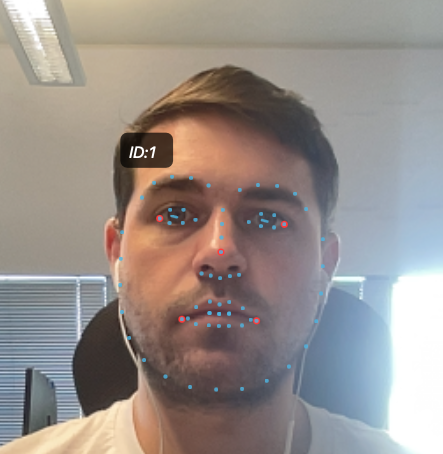
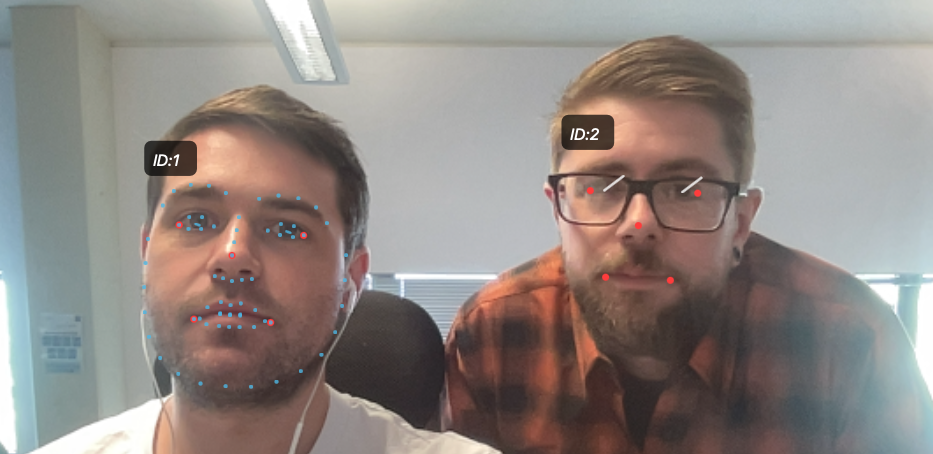
- Multi-Person Identification: The capability of the SDK to detect, register, and track multiple occupants simultaneously within the camera's field of view.
-
Identity Reference: The snapshot visual thumbnail extracted from a valid frame and displayed in the Visualiser header, enabling researchers to visually verify which occupant corresponds to a given Subject ID.
-
Baseline: The subject-specific resting facial morphology reference (landmark mesh and Action Unit zero-points). When the baselining pipeline is active, all subsequent Action Units, Valence-Arousal values, and Emotion Zone probabilities are calibrated relative to this reference frame.
-
Face Count: The total number of unique, valid human faces detected in a specific frame or registered during the initial discovery pass (
num_faces). -
Status: The real-time operational state of the video processing queue, SDK, or active subject tracking.
¶ 5. Signal Quality, Reliability & Head Pose
-
Face Validity: The percentage of recorded video frames where a subject’s facial bounding box and 68-point landmark mesh were successfully detected and verified with acceptable model confidence.
-
Reliability: An aggregate system quality score reflecting model visibility, tracking continuity, and signal stability across the session.
-
Environment Quality: An aggregate score outputted as a percentage () calculated across multiple environmental inputs—including whether the video is too blurry, too bright, too dark, or if the face is not properly framed.
-
Detect Eye Obstructions: A boolean flag (
true/false) raised when the Action Units and landmarks around the ocular region are invalid, indicating partial or complete obstruction. -
Detect Mouth Obstructions: A boolean flag (
true/false) raised when the Action Units and landmarks around the oral region are invalid, indicating obstruction by hands, microphones, masks, or objects. -
Visual Voice Activity (VVAD): Visual-only speech detection estimating whether an occupant is actively speaking based on lip dynamics and oral opening/closing cadence, independent of audio signals.
-
Head Pose: The 3D spatial orientation of the subject's head relative to the camera axis, quantified across three rotational axes:
-
Yaw Deviations: Lateral rotation (turning head left or right; negative values indicate yaw toward central in-cabin displays or side mirrors).
-
Pitch Deviations: Vertical tilt (nodding head up or down; downward pitch commonly marks gaze toward consoles or phone interfaces).
-
Roll Deviations: Lateral tilt (tilting the head side-to-side toward either shoulder).
-
Extreme Angle Frequency: The proportion or frequency of frames where head rotation exceeds acceptable model tracking angles.
-
-
Gaze Vector Projection: 3D directional vectors calculated from pupil and eye landmark geometry estimating the occupant's line of sight into the cabin or testing environment.
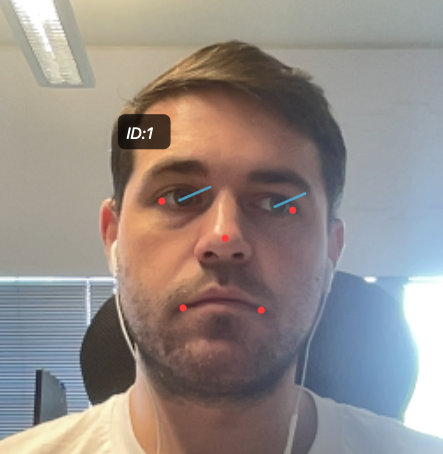
- Gaze Distribution Map: A 2D heatmap visualizing gaze density throughout the session, mapped with the X-axis representing Yaw (left to right) and the Y-axis representing Pitch (up to down).
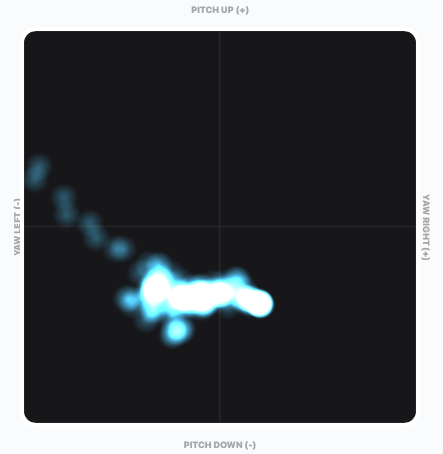
¶ 6. Action Units & Facial Dynamics
-
Muscle Activation: Numerical intensity scoring corresponding to the contraction of specific facial muscle groups (FACS Action Units).
-
Facial Muscle Peaks: The highest percentage peak of activation reached by a specific Action Unit (e.g., peak contraction of AU04 Brow Lowerer or AU12 Lip Corner Puller) during the recorded session.
¶ 7. Video Processing & SDK
-
Original FPS: Runs the SDK processing at the native capture framerate of the ingested video container file (commonly or ).
-
Base FPS: The standardised target framerate for SDK video processing ().
-
Total Frames: The absolute count of image frames recorded and evaluated across the duration of the media file.
-
Video Splicing: The operation of selecting a range (start and end timestamps) to synchronously export a trimmed
.csvsegment and an aligned.mp4video clip. -
SDK Latency: The processing time elapsed between ingesting a frame into the core C++ SDK and receiving the computed output.
-
Application FPS: The real-time rendering and playback framerate maintained by the desktop frontend application while syncing charts, overlays, and video playback.
¶ 8. Hardware & UI System States
-
Active Camera Source: The designated physical or virtual imaging device used during live analysis.
-
Active Microphone Source: The designated audio capture device feeding sound input into live analysis.
-
Light Mode: Visualiser’s high-contrast, light-palette interface theme designed for brighter environments and printed PDF documentation exports.
-
Dark Mode: Visualiser’s low-emission, dark-palette interface theme designed to reduce visual fatigue during extended video analysis in dim testing environments.
¶ System Requirements & Hardware Specifications
The Blueskeye Visualiser desktop application operates an integrated dual-engine runtime: a native C++ computer vision and neural inference core (BM.BSocial-lib, OpenCV) communicating via a low-overhead Rust FFI layer (src-tauri) with a high-performance React/Vite dashboard.
Because video stream decoding, 68-point facial landmark mesh tracking, Action Unit inference, and real-time temporal charting execute concurrently on the client machine, performance is directly bounded by CPU vector extensions, available unified or system memory, and hardware video decoding throughput.
| Component | Minimum Operational Profile | Recommended Enterprise Profile |
|---|---|---|
| Operating System | macOS 12 Monterey or higher Windows 10 64-bit (Build 19041+) |
macOS 14 Sonoma or higher Windows 11 64-bit |
| Processor (macOS) | Apple Silicon M1 (8-core CPU, 4 performance + 4 efficiency) | Apple Silicon M2 Pro / M3 Pro or higher |
| Processor (Windows) | Intel Core i5 (6th Gen or newer) / AMD Ryzen 3 1200+ (requirement: AVX2 / FMA3 support) |
Intel Core i7 (12th Gen+) / AMD Ryzen 7 (5000 series+) 8+ physical cores |
| Memory (RAM) | 8 GB Unified Memory / System RAM | 16 GB+ Unified Memory / 32 GB System RAM |
| Graphics / Acceleration | Integrated GPU with hardware H.264/AVC decode (Intel HD 520+, Apple M-series GPU) | Dedicated GPU (NVIDIA RTX series with NVDEC) or Apple M-series with unified Neural Engine |
| Disk Storage | 2 GB available SSD space | 5 GB+ high-throughput NVMe SSD |
| Display Resolution | pixels | (Full HD) or higher |
| Capture Interface | USB 2.0 (UVC-compliant, 720p @ 30 FPS) | USB 3.2 / Thunderbolt (1080p @ 60 FPS, low latency) |
¶ Reference Test Environment (Internal Validation)
The Visualiser platform has been benchmarked and validated under the following standard portable hardware profiles:
| Parameter | Validation Environment Specification |
|---|---|
| System Model | MacBook Air (13-inch, M1, 2020) |
| Operating System | macOS Sequoia / Tahoe (Apple Silicon Native) |
| Processor (SoC) | Apple M1 (8-core CPU, 7/8-core GPU, 16-core Neural Engine) |
| Unified Memory | 16 GB LPDDR4X |
| Binary Architecture | aarch64-apple-darwin |
| Observed Throughput | Real-time analysis at 58–60 FPS (1080p source) |
| Installation Size | ~556 MB |
| Memory Footprint | ~1.4 GB RSS active working set (nominal) |
| FPS Processing SDK Latency | 50-60ms |
| Parameter | Validation Environment Specification |
|---|---|
| System Model | Surface Pro12 |
| Operating System | Window 11 Pro |
| Processor (SoC) | Snapdragon x+ 8 core 3.3ghz |
| Unified Memory | 16 GB LPDDR5 |
| Binary Architecture | arm64 |
| Observed Throughput | Real-time analysis at 55-60 FPS (1080p source) |
| Installation Size | ~514 MB |
| Memory Footprint | ~1.2 GB RSS active working set (nominal) |
| FPS Processing SDK Latency | 30-50ms |
| Parameter | Validation Environment Specification |
|---|---|
| System Model | Lenovo |
| Operating System | Windows 10 |
| Processor (SoC) | i5 1135G7 2.4ghz |
| Unified Memory | 8 GB LP DDR4 |
| Binary Architecture | aarch64 |
| Observed Throughput | Real-time analysis at 30–60 FPS (1080p source) |
| Memory Footprint | ~2 GB RSS active working set (nominal) |